
Application Development
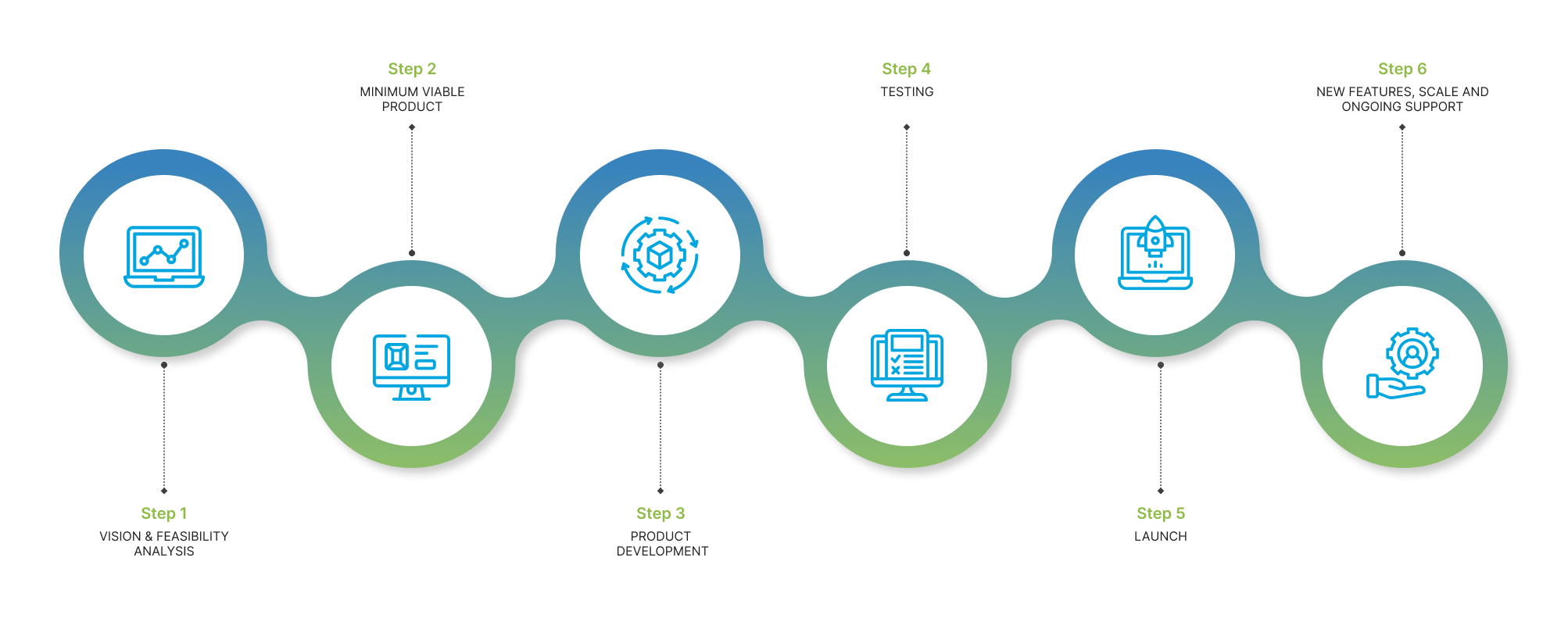
Step 1: Vision & Feasibility Analysis
Founders or SBU Heads often come to us with a strategic vision for a market need. At this stage, the vision is typically a high-level overview of what the product is expected to achieve. We work with our customers to evaluate whether the product can be developed within the current technical, business, and operational constraints. If the idea is feasible, we move forward with a Proof of Concept (PoC) that can lead to a Minimum Viable Product (MVP). If the product is not feasible at the time, we help refine the vision and adapt it to the constraints that exist at that stage. Our goal is to turn the idea into a realistic, actionable direction without losing the core market opportunity.
The outcome of this step is a consolidated Feasibility Analysis report and a clear Go/No-Go decision for MVP development.
Step 2: Minimum Viable Product
A Minimum Viable Product (MVP) is rhe first complete version of a Proof of Concept. It includes only the essential features needed to solve the core problem, without extra bells and whistles.
At this stage, the product is functional enough to be tested with your target audience. This allows you to gather real user feedback, validate assumptions and hypotheses, and make informed improvements before investing in full-scale development.
An MVP helps you move quickly and cost-effectively while reducing risk. By testing early with real users, you can course correct based on evidence rather than assumptions..
Step 3: Product Development
After the MVP is validated, we move into full product development through iterative prototyping, testing, and refinement. At this stage, we define the product architecture, design the UX/UI, and shape customer journey to ensure the product is scalable, user-friendly, and ready for changing market needs.
Our teams build the product using industry best practices such as Agile and DevOps, with a strong focus on time to market, quality, and profitability.
Step 4: Testing
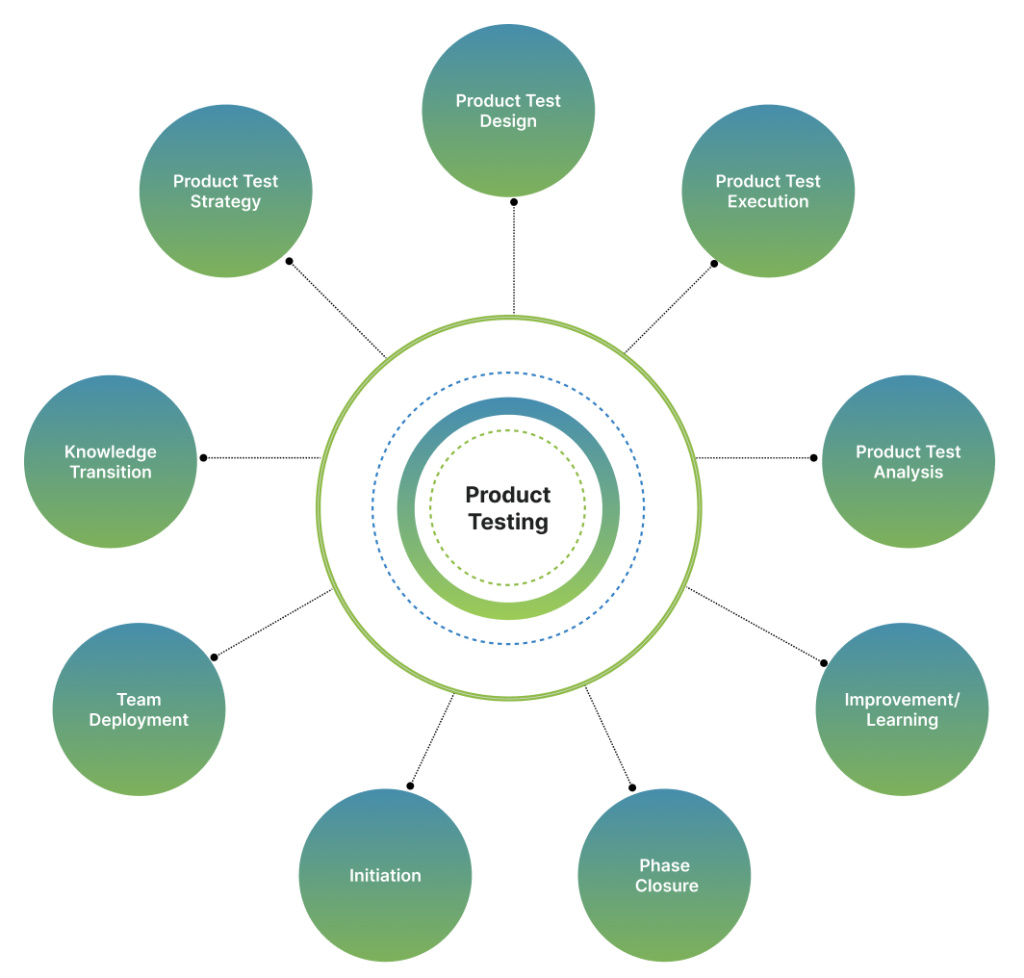
We use multiple testing approaches across product development to verify functionality, performance, usability, resilience, and compatibility. Ecotech follows a proven independent testing methodology that can be customized to meet the specific needs of each client and application.
Clients can engage us exclusively for testing services, including testing management and consulting, core software testing, and specialized testing. Our services cover test strategy, test plans, test cases, execution, and result analysis, along with system, integration, regression, performance, and user acceptance testing.
We also provide mobile and web application testing, as well as manual and automation testing. As an independent third party, we help validate requirements, uncover defects, test boundary conditions, assess recovery, and measure performance under peak load.
Step 5: Launch
Step 6: New features, scale and ongoing support
From the start, we work with you to refine the product vision and build an architecture that can support complex features, diverse user expectations across geographies, and evolving business requirements.
Ecotech ensures that product scale never comes at the cost of performance or security. We design solutions that can handle a growing feature set and an expanding user base with stabiltiy and ease.
Our support continues beyond launch, with ongoing performance improvements and maintenance throughout the product lifecycle, until end of life or planned obsolescence.